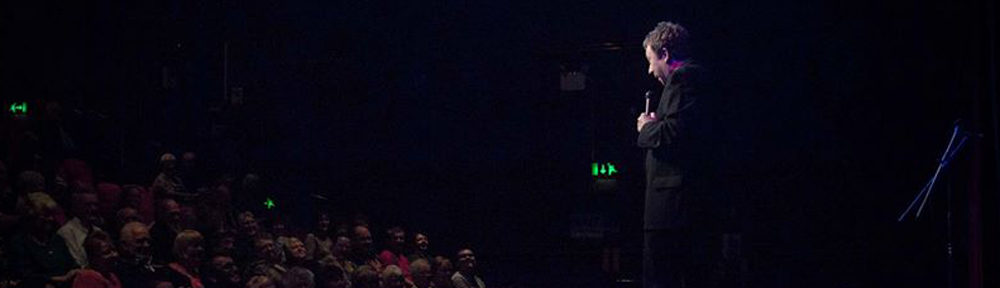
There’s been a noticeable change in attitude towards ‘bad’ language.
It seems people are less likely to be offended by comedians using four-letter words than they are by ordinary people expressing their personal opinions.
Yet, in 1972, the American comedian George Carlin first performed a routine now regarded as a classic, called “The Seven Words You Can’t Say On Television” – and, if you think I’m prepared to list them, you’re going to be disappointed.
Besides, his routine is available to view online, but refrain from doing so if there’s anyone of a delicate nature in the room.
Although he performed the routine on stage for many years afterwards, ironically, it got its biggest audience when he incorporated it into an HBO TV special (he made 14 in all), by which time many TV viewers had heard most of the ‘forbidden’ words.
Today, we’re routinely exposed to them on terrestrial TV, often just after the watershed, and anytime on streaming services.
Which might explain why so many people feel free to use them in public.
A mate of mine and his wife were recently walking their daughter’s small dog for her while she was away and as they passed a young man wearing shorts, the dog suddenly snapped at his heels, not actually biting him.
However, the man reacted with a torrent of obscenities that would have made a sergeant-major blush, including variations of the strongest two in the English language, feeling no compunction to temper his words because he was in the presence of a middle-aged woman.
When my mate asked him to “Watch his language” the man just carried on swearing loudly, but before the situation could escalate into a nasty confrontation, the young man suddenly seemed to realise what he’d said and hastily apologised before walking off.
My friend ruefully observed that the young man’s instant verbal reaction included the two words once only heard in male company and that 20 years ago he might have been a little more careful with his language.
Maybe we should start a list of “Seven Words You Shouldn’t Say In Front Of A Lady!?
Monthly Archives: November 2025
Fashion vs. Function in Swansea’s Frigid Streets
I don’t know about you, but this recent cold snap has left me feeling like a popsicle!
Seriously, at this rate, I’ll be unearthing my thermal underwear from its hibernation since last winter’s holiday.
I can practically hear it groaning, “Not again!”
So, there I was on Saturday night, taking a stroll down Wind Street in Swansea, and, let me tell you, the fashion choices were nothing short of baffling.
Picture this: I’m bundled up like a yeti, complete with a scarf that could double as a sleeping bag, while the majority of the nightlife crowd is strutting around in bare legs and flimsy tops.
I swear, I saw a woman wearing a crop top that was more ‘crop’ than ‘top’. Clearly, she had mistaken “chilly” for “chic.”
Now, don’t get me wrong, I admire a good sense of style, but come on!
When did practicality become the ugly stepsister of fashion?
I mean, I get it, fashion is all about making a statement. But what statement are we making when we’re one gust of wind away from a full-blown ice sculpture?
I’ve reached that glorious age where comfort trumps catwalk looks.
I’d rather rock a cosy sweater than freeze my buns off in some haute couture nightmare.
Seriously, I’d take a well-worn thermal onesie over a designer dress any day. Nothing says ‘I’m fabulous’ quite like a onesie that’s seen more Netflix marathons than social events.
So, here’s my plea to the fashionistas of Swansea: can we swap out the flimsy for the fuzzy just this once?
Let’s embrace the warmth. After all, if it comes down to fashion statements or frostbite, I choose to be the warm and happy one, preferably with a hot cocoa in hand.
And, let’s be real, nothing is more stylish than being able to feel your toes.
So, the next time you’re out and about, remember: it’s not just about looking good; it’s about staying warm enough to enjoy the night without turning into a human icicle.
Cheers to cosy fashion, folks.
HAS ‘REMEMBER, REMEMBER’ BEEN FORGOTTEN?
“Remember, remember the 5th of November!” was the seasonal rhyme that we youngsters used to chant in the weeks running up to the excitement of Bonfire Night celebrations.
Mind you, a combination of November downpours and the fact that every box of fireworks seemed to contain the odd one or two that fizzled out disappointingly in a couple of seconds, often meant the evening’s fun turned out to be a bit of a (pardon the pun) damp squib!
“Light up the sky with Standard Fireworks,” went the song in the TV ads.
I can’t recall what make of fireworks we had at home, but I doubt they were Standard or Brocks, who were both major names in the firework firmament.
I suspect the fireworks we had must have been ‘bargains’ bought just before the shops shut on November 5th, because my favourites, the rockets, didn’t have enough firepower to light up one of my gran’s ciggies, let alone the night sky.
I tend to mention, most years on this very page, that over the past couple of decades parents have been spending tons more money on Halloween-related costumes, party food and suitably macabre plastic and rubber ‘scary’ props than on fireworks.
Despite October 31st overtaking November 5th as the much-anticipated date in the autumn calendar, fireworks are still purchased and enjoyed.
I don’t know how many of today’s kids are familiar with “Remember, Remember the 5th Of November” and recite it, because I obey the cautionary advice that’s written on bottles of strong cough medicine, boxes of painkillers and powerful chain saws used for felling giant Californian Redwoods – ‘Keep Away From Children’.
But it’s struck me in recent autumns that some of the young un’s (and not-so-young-un’s) around our way have mis-heard the rhyme during their formative years and believe it goes something like “Remember, Remember the 8th or possibly 11th or maybe 29th of September” . . . because those are some of the dates I’ve first started hearing loud ‘bangs’ as fireworks are let off in the evening.
Dear, oh dear! Doesn’t Tik Tok teach these kids anything useful?
Remembrance Sunday. A Heartfelt Reflection on Sacrifice and Hope
As I sit down to write this week’s column, I feel an overwhelming urge to reflect on Remembrance Sunday, a day that resonates deeply for countless individuals across the United Kingdom and the Commonwealth.
It’s a solemn occasion, yes, but it’s also a heartwarming reminder of the courage and resilience that transcends generations.
Some time back, I delved into the significance of the poppy, that little red flower that has become a symbol of remembrance.
To my surprise, I learned that it was inspired by the haunting lines of the World War One poem “In Flanders Fields.”
The opening lines evoke a powerful image of vibrant red poppies flourishing amidst the devastated landscapes of soldiers’ graves in Flanders, a region in Belgium that bore witness to unimaginable loss.
These delicate flowers, emerging from the churned earth, stand as a testament to life persisting in the face of death, a poignant reminder that even amidst despair, hope can blossom.
It’s like finding a bright red poppy in a field of grey; it’s a little nudge from the universe saying, “Hey, life goes on!”
Remembrance Sunday is not just a date on the calendar; it’s a sacred moment to honour those who have given their all for our freedoms.
It invites us to pause and reflect on the heavy price paid for our choices and the liberty to express our thoughts.
It’s a day to acknowledge that our voices, including mine (with the editor’s approval, of course), are the result of countless sacrifices made by brave souls who believed in a future where freedom reigns.
As we gather to remember, let us carry forward the legacy of those who served, ensuring that their stories and sacrifices are never forgotten.
This day, and the symbol of the poppy, implore us to honour their memory with gratitude and resolve.
So, as you don your poppy this Remembrance Sunday, take a moment to reflect, not just on the past, but on the present and future we are building.
Let’s celebrate the resilience of the human spirit and the hope that blooms even in the darkest of times.
After all, if a little flower can thrive in the most challenging conditions, so can we.